
Finding Hidden Family Connections Through Creative Genealogy Research
 8
8Oct
A marriage record identifies a bride, a groom, and a wedding date. A death certificate records when someone died. A census, where a family lived at a point in time. But what about the minister who performed the ceremony, neighbors with similar surnames, or faint markings that look like nothing? Those details can change the direction of an entire research project. Sometimes what appears to be an impossible brick wall, in reality, just needs a new, sharper pair of eyes!
Pearl Bohannon lived with Alex Daniel Presnell in the 1930 census. They had four children born between 1920 and 1930. What happened to her after 1930 and who her parents were was proving difficult to find, so the client hired Price Genealogy to solve this brick wall mystery. Pearl’s story illustrates how creative genealogy research works in practice. It means carefully noticing every piece of information on a record, asking new questions of familiar sources, and investigating the people around your ancestor.
Research the Children to Learn About the Mother
When records about an ancestor are scarce, relatives may preserve information that the ancestor’s own records omit. Pearl’s children offered several opportunities to learn her full name and establish a more reliable timeline.
Her son Alex Delbert Presnell’s Social Security record named his mother as “Pearl B Bohann.” His 1924 birth certificate supplied the fuller name Pearl Beatrice Bohannon. It also recorded her age as twenty-three, her birthplace as Missouri, and that this was her second child. These details were valuable. The middle name helped distinguish Pearl from other women. Her reported age suggested a birth around 1901, earlier than the estimate from the 1930 census. The statement that Delbert was her second child provided another point to compare with the known family structure.
Her daughter Maxine’s obituary also named her mother as Pearl Beatrice Bohannan Presnell. The spelling varied, but the combination of given names, married surname, and family relationships supported the identification.
Other children’s records were not as useful. Her son William’s obituary did not mention his mother, and the records found for daughter Nadine did not name her parents. Researching several children gives you multiple chances to find a useful detail and compare accounts rather than depending on a single source.
Be Careful about Relationships Mentioned in Obituaries
An obituary may call someone a brother, sister, or child without explaining whether the relationship was full, half, or step. The obituary for Alex Presnell was located, stating that he died on 27 September 1967. Unfortunately, there was no mention of his first wife, Pearl. He was killed when he was struck by a train. His surviving wife, Mrs. Becky Presnell, was mentioned, along with four sons and two daughters.
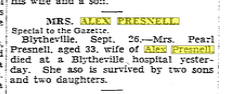
An obituary was also located for Pearl Presnell. It was reported on 26 September 1934. She was the “wife of Alex Presnell,” and was survived by two sons and two daughters.
Daughter Maxine’s obituary named Harry Presnell among her surviving siblings. A public-records entry identified Harry Joe Presnell with a birth date in August 1940. Pearl had died in 1934, and Alex had remarried in 1935. If the entry identified the correct Harry, he could not have been Pearl’s biological son. That finding corrected an early working assumption about the children. It also showed why an obituary’s relationship labels should be interpreted within the family’s timeline.
Census households can likewise bring together children from different marriages. Dates help determine which relationships are possible. Whenever a new relative appears, compare the birth date with the parents’ marriages, deaths, and residences. A shared surname and a place in the same family circle are useful clues, but they do not establish the precise relationship. Leave room for blended families and revise your working reconstruction as evidence develops.
Compare Every Detail Without Forcing Agreement
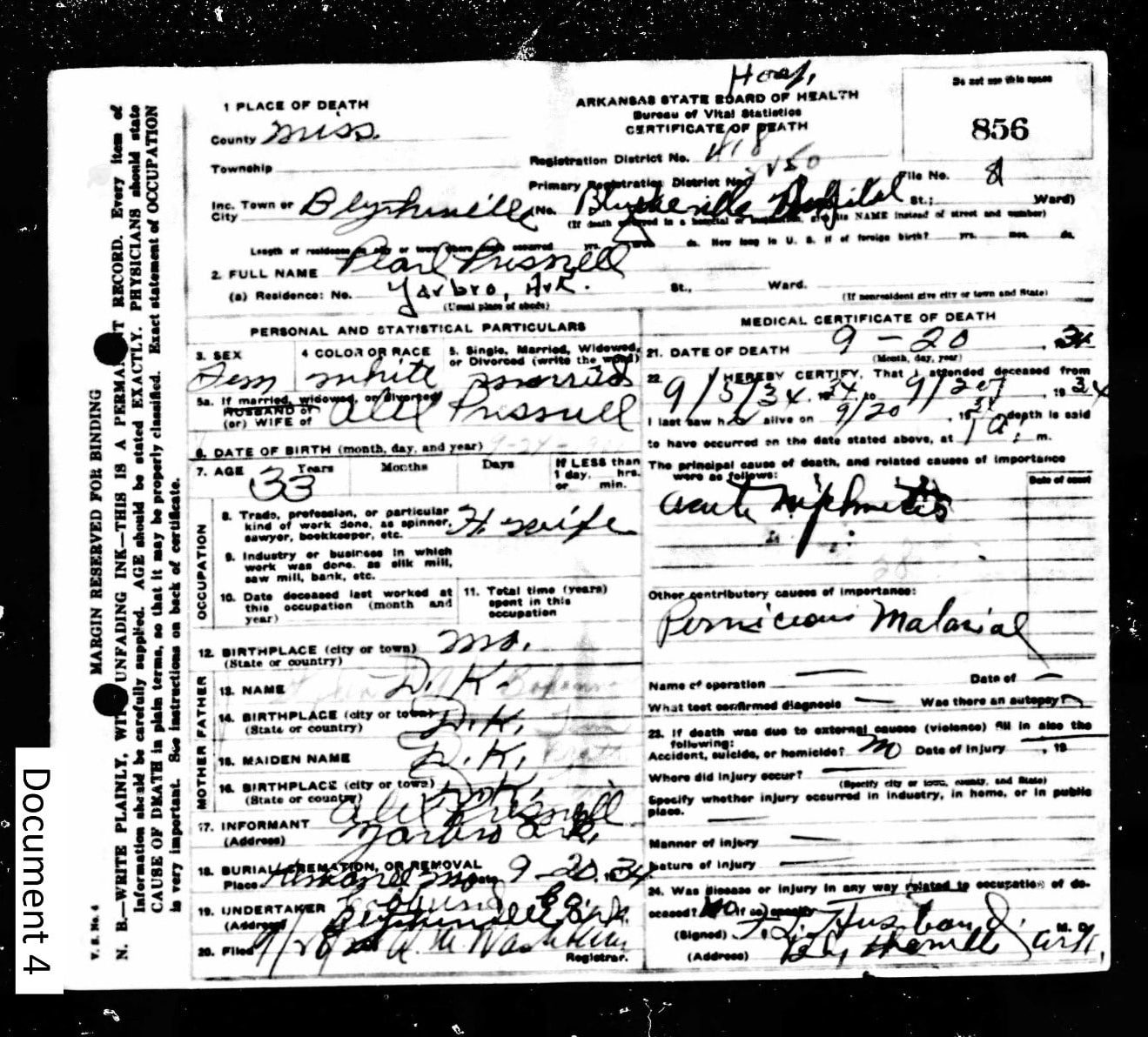
Knowing that Pearl died in 1934 from her obituary, we were able to locate her death certificate. She died on 20 September 1934. Her birth date was recorded very faintly but was 24 September 1901, in Missouri. This was slightly off from the 1930 census, in which her estimated birth year was about 1904. The informant was her husband, Alex Presnell, and unfortunately the names of her parents were recorded as “D.K.” for both father and mother. Apparently, Alex did not know his in-laws very well.
It’s important to ask who supplied each piece of information and how likely that person was to know it. A husband might know his wife’s recent residence but have incomplete knowledge of her parents. A census age might be approximate. Several statements on one document may have different levels of reliability. Avoid selecting whichever detail best fits your preferred theory. Compare the sources, explain the conflicts, and distinguish a reported fact from your interpretation of it.
Read the Entire Record
In the 1930 census, Pearl was living with husband Alex and their children. Her reported age was twenty-six, and her age at first marriage was sixteen. Alex’s reported age at first marriage also pointed toward a 1919 wedding.
Pearl Bohannon and Alex Presnell’s marriage was located on 7 December 1919 in New Madrid County, Missouri. It can be tempting to record only the date and location, and then move on to other records. But when reviewing a document, it’s important to transcribe all its relevant information, including witnesses, occupations, addresses, informants, officiants, and annotations.
Pearl and Alex’s 1919 marriage license contained more than their names. Alex was identified as a resident of Matthews, Missouri, and Pearl as a resident of Morehouse, Missouri. The license stated that Alex was over twenty-one and Pearl was over eighteen, which would match her 1901 birth. They married in Morehouse, with the ceremony performed by Reverend M. L. Hinchey, identified as the resident pastor of the Nazarene church in Caruthersville. It took some time to decipher the identity of the officiant, but it turned out to be very valuable!
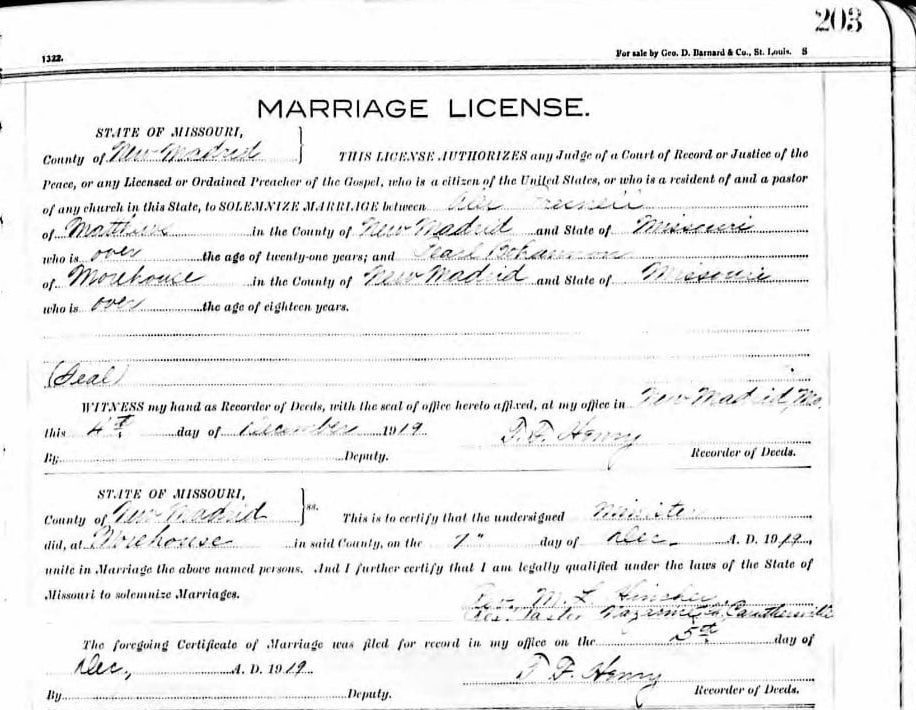
(Here is a magnified image of the recorded marriage officiant.)

Each detail here was very important. The residences helped define the couple’s geographic setting. The age statements provided a framework for their birth years. The minister’s name introduced another person whose connection to the couple could be investigated. There’s a lot to keep in mind when examining a record. For example, take note of headings and printed instructions so you understand what the handwritten answers mean. Remember, a residence is not necessarily a birthplace, and the date a record was filed may differ from the date of the event.
You may not immediately know why a detail matters. Recording it now allows you to recognize its importance when another source supplies the missing connection.
Eliminate Similar Names Through Their Life Stories
Several Pearl Bohannons were plausible candidates by name and approximate age. Distinguishing them required following their families and later lives.
One Pearl appeared in a Missouri household with William and Mattie Bohannon. Information associated with Mattie’s obituary identified a daughter Pearl Button, later Pearl Williams, who was living in Texas in 1944. That evidence pointed away from Pearl Presnell, who had died ten years earlier.
Another Pearl H Bohannon was found in the household of William and Mary Bohannon in Springcreek, Missouri – 150 miles from Morehouse. Distance can help evaluate a candidate, but it should not be the sole reason for rejection. People moved. A later marriage, a continuing household, or a documented death can provide a more decisive distinction than miles between two towns. It turned out this Pearl married a John Vandyke Jacks in 1920.
Another Pearl Bohannon married Bryan Jones in Arkansas in 1917. The couple was found together in the 1950 census, providing evidence that this was a different woman.
Keep a record of eliminated candidates and the evidence behind each decision. This prevents repeated work and helps explain why a tempting same-name match was not accepted.
Follow the People Around Your Ancestor (FAN research)
After direct searches failed to identify Pearl’s parents, Bohannons living in or near Morehouse around the time of Pearl’s marriage were sought. That broader approach uncovered a 1903 marriage between Claudia Bohannon and Luther Hinchy. Although this marriage was 16 years before Pearl’s 1919 marriage, the surname caught our attention.
The name Luther Hinchey resembled that of Reverend M. L. Hinchey, who performed Pearl’s wedding sixteen years later. Could the minister be related to Claudia Bohannon, or even perhaps have married a woman from Pearl’s family?
Research into Martin Luther Hinchey produced an online memorial identifying his wife indeed as Claudia Leola Bohannon! It named Claudia’s parents as Stephen Alexander Bohannon and Cordelia Ellen Pratt. Because the memorial was unsourced, the information needed verification. Nevertheless, it supplied a specific family to investigate and a possible explanation for the officiant’s involvement.
This approach is often called researching an ancestor’s friends, associates, and neighbors, or the FAN club. Here, a minister’s identity suggested a connection that searching only for Pearl had missed. It’s important to note that at this point, the connection did not establish whether Claudia was Pearl’s sister, aunt, mother, or another relative. Also, a minister certainly married couples unrelated to himself. Its value was that it created a testable hypothesis. Creative research becomes productive when an intriguing association leads to a focused search for supporting evidence.
Return to Records That Seemed Disappointing
Pearl’s death certificate initially appeared to offer little help with her parentage. The father and mother fields contained the bold abbreviation “D.K.,” understood as “Don’t Know.” After the Hinchey and Bohannon connection emerged, the certificate was examined again. Beneath the dark entries for her parents’ names was faint writing that appeared to name Stephen Bohannon, of Tennessee, and a mother with the surname Pratt. These were completely missed during the first reading because they were buried under the dark and confident “D.K.” Take a look and ask yourself if you would have noticed them the first time. And even if you did, could you decipher the full names?
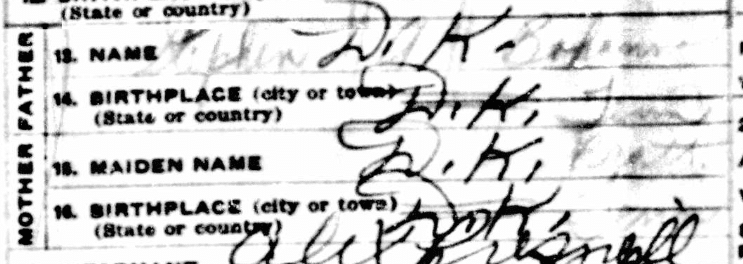
The names of Pearl’s parents aligned with the parents suggested by Claudia’s memorial. The death certificate had not changed; the questions being asked of it had. Names that might once have been difficult to recognize now had a context for comparison. The apparent names were meaningful evidence, but their position beneath “Don’t Know” required careful interpretation. They supported further research rather than settling Pearl’s parentage by themselves.
Search Around Missing Records
The Stephen Bohannon family was located in the 1900 and 1920 censuses, but not in 1910. That missing enumeration was especially important because Pearl’s apparent 1901 birth and 1919 marriage placed her childhood between those two known census entries. A probate record was sought for Stephen A Bohannon which might name his posterity, without success.
Other family records helped narrow the search. Claudia’s siblings were traced to determine where the family was living about 1910. Early May Bohannon was described as a Morehouse resident at her 1904 marriage. G. W. Bohannon was associated with Sikeston in 1911, five miles east of Morehouse. Gladstone Bohannon was associated with Canalou in 1922, six miles south of Morehouse. And a brief newspaper entry in 1923 referred to “S.A. Bohannon,” introducing initials as another search possibility. These places suggested that the family was heavily concentrated around New Madrid and Scott counties. Still, they have not been found in the 1910 census.
When a record remains elusive, search for individual family members, spelling variants, initials, neighbors, and known locations. Consider browsing the relevant enumeration district. Use surrounding records to reduce the search area and document what you have actually examined. Frustratingly, a manual search of the 1910 census for Morehouse did not locate the Stephen Bohannon family.
The Final Piece to the Puzzle
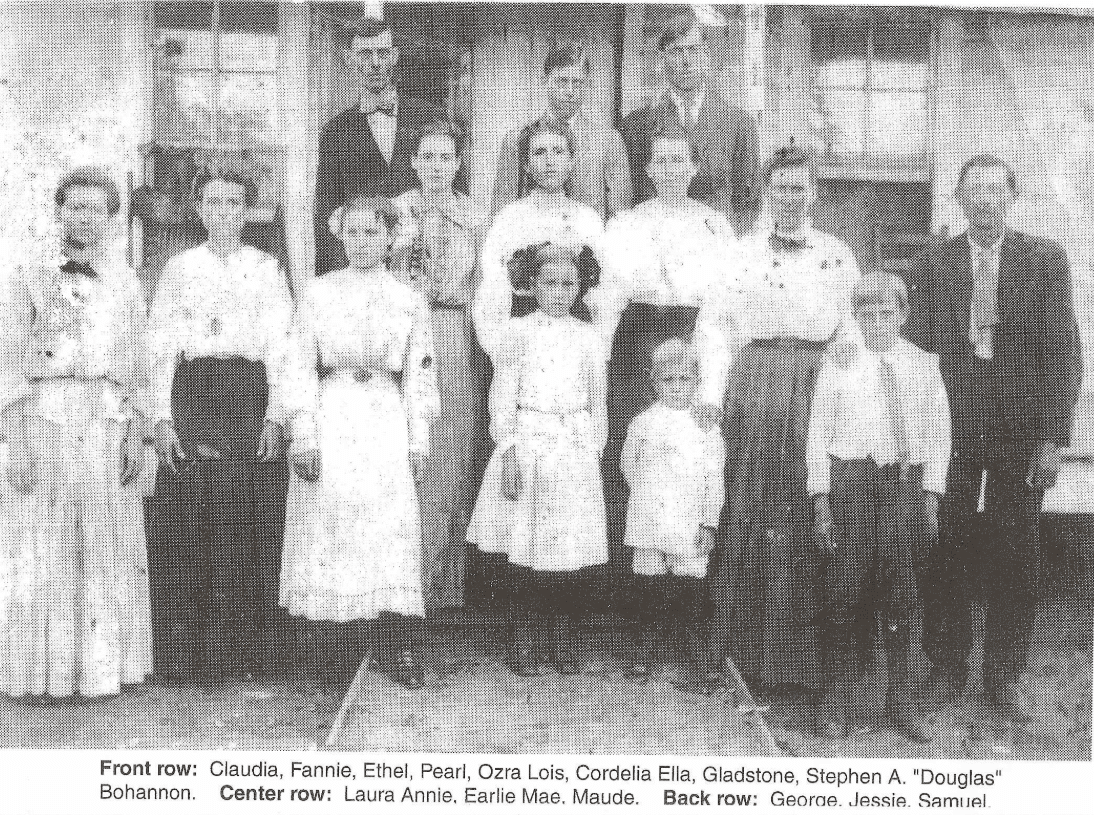
A search of online trees for each member of the Stephen Bohannon family located a family picture for Stephen A Bohannon and his wife, Cordelia Ella, along with their 12 children. Listed among them is Pearl! Using online AI tools, the picture was dated between 1908 and 1912. Pearl appears to be about age 8 or 9, consistent with a birth in September of 1901. This picture is a snapshot in time when the missing 1910 census would have recorded this family living together.
Turn Small Clues Into a Research Plan
Pearl Bohannon’s family was finally found! Searching for others with her surname in Morehouse led to the marriage of Claudia Bohannon to Hinchy. A careful reading of Pearl’s marriage record noted that she was married by a Reverend L. M. Hinchey. Research into Claudia Bohannon revealed she married this same Rev Luther Martin Hinchey. Claudia was the daughter of Stephen Bohannon and Cordelia Ellen Pratt. Pearl’s death record was located by first uncovering her obituary in 1934. An initial reading of her death record failed to identify the names of her parents; however, closer scrutiny noticed that very faintly written under “D.K.” (or “Don’t Know”) were the names Stephen Bohannon and mother “Pratt.” These names were now recognizable after learning more about Claudia Bohannon.
The final piece of circumstantial evidence was uncovered by researching online sources for Claudia’s siblings and locating a family photograph, dated from around 1910, in which Pearl was photographed with Stephen and Cordelia Bohannon and their other 11 children.
Further research could seek records naming Pearl as a daughter or sister, continue investigating the family’s other children, and continue the search for the missing 1910 census household. DNA comparisons between appropriate descendants might contribute additional evidence when interpreted alongside the documentary research.
The practical lesson is to give every detail a chance to guide your next question. Before setting your next record aside, read it again with Sherlock Holmes-like attention to detail. Record what it says, identify what remains uncertain, and ask which person, place, or annotation offers the most useful next step. That habit can turn a routine document into a path toward an ancestor’s family.
And if you feel stuck, reach out to Price Genealogy. We would love to help you break down your brick walls.
Emily
Images:
- Canva AI-generated photo by the author.
- Arkansas Gazette, Little Rock, Arkansas, September 27, 1934, “Mrs. Alex Presnell,” obituary for Pearl Presnell; index with images, GenealogyBank (https://www.genealogybank.com: accessed 8 June 2026).
- Arkansas, Death Certificates, 1914-1969, Pearl Prisnell, d. 20 Sep 1934; index with images, image 865 of 3502, Ancestry (https://www.ancestry.com/search/collections/61777/records/350805?tid=&pid=&queryId=b20d5b03-8b08-406b-862d-4a840c029220&_phsrc=FtV3227&_phstart=successSource: accessed 8 June 2026).
- Missouri, County Marriage, Naturalization, and Court Records, 1800-1991, New Madrid, New Madrid, Pearl Bohannon and Alex Presnell, mar. 7 Dec 1919; index with images, image 205 of 363, FamilySearch (https://www.familysearch.org/ark:/61903/1:1:WPSX-VJZM?lang=en: accessed 8 June 2026).
- Ancestry Public Member Tree, Chuck-Shelby, Charles Shelby family tree, originally shared on 29 Jun 2012 (https://www.ancestry.com/mediaui-viewer/collection/1030/tree/43206641/person/12670338952/media/7578b542-c727-4239-b268-fac97cb907b0?: accessed 8 October 2026).