
Appalachian Genealogy: Lessons Learned from Researching Dolly Parton’s Family Tree
 17
17Sep
Dolly’s legacy
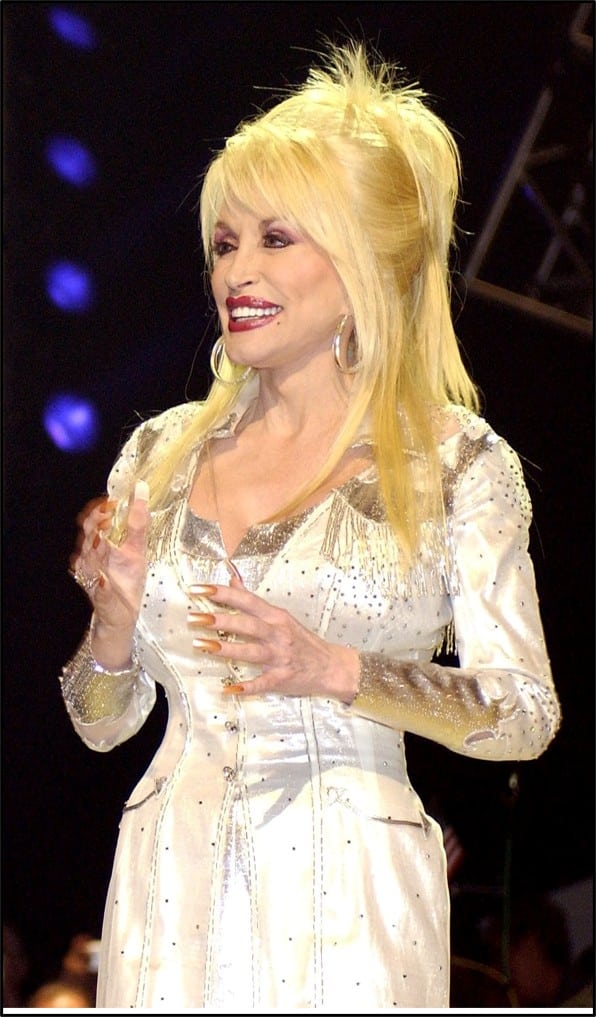
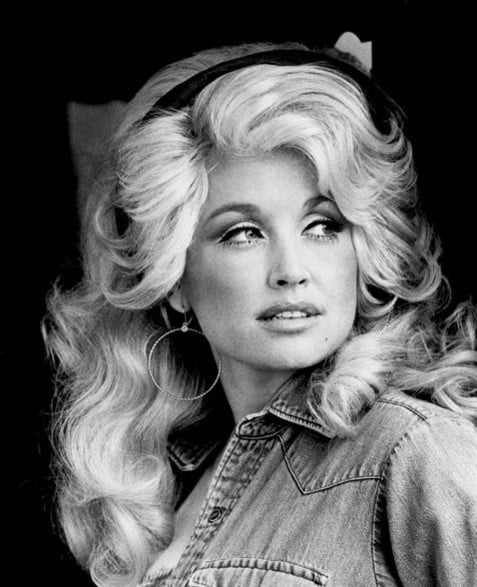
The world lost legendary, iconic country music star and actress Dolly Parton on August 25, 2026. She passed away at the Vanderbilt-Ingram Cancer Center in Nashville, Tennessee, aged 80.
Born on 19 January 1946, in Pittman Center, Tennessee, Dolly Rebecca Parton and her 11 siblings were raised in the foothills of the Smoky Mountains in Sevier County. Her father, Robert Lee Parton, was a sharecropper and tobacco farmer. Her mother, Avie Lee Owens Parton, was a homemaker and raised her twelve children in a small, two-room cabin.
Dolly has credited her mother’s family for her natural talent and passion for music. Early in her career, her uncle, Bill Owens, became her songwriting partner. She started on the radio as a child and appeared on The Cass Walker Show in Knoxville at age 10. At 12, she recorded her first single, “Puppy Love.”
A day after graduating from Sevier County High School, she left her small Tennessee cabin and moved to Nashville. In 1967, Dolly was invited to join The Porter Wagoner Show, a weekly syndicated television show, and was signed with RCA Victor. Her first solo with the label, “Just Because I’m A Woman,” reached number 7 on the charts in 1968. Porter and Dolly’s duets continued to be a success. Dolly decided to part ways with Porter in 1974, and that event became the inspiration for her song, “I Will Always Love You,” which went number one on the charts. Throughout her long career, she published 49 solo albums and nearly 960 songs. She was also known for her acting, with works such as “9 to 5” and “Steel Magnolias,” and appearances on Disney Channel’s “Hannah Montana.” Her career spanned nearly seven decades, and she has been loved and inspired by generations of people.
Working from the known to the unknown
When trying to answer any genealogical question, you should work from the known information to the unknown. Dolly has been very public about her family, and many of them have appeared on stage with her. Her parents are Robert Lee Parton and Avie Lee Owens, and her siblings are Willadeene, David, Coy, Robert, Stella, Cassie, Randle, Larry, Estel, Freida, and Rachel.
Census records are usually the first records genealogists seek to learn more about a person and their family. The federal census is taken every 10 years and provides a snapshot of a person’s life and their family structure. The 1950 census recorded Dolly and her family in Sevier County. [1] They lived “four miles on the right” on Burchfield Road. Dolly was four years old and lived with her parents and siblings Willa, David, Denver, Bobby, and Stella. Next door were Walter and Bessie Parton, Dolly’s grandparents. The census recorded more than just names, ages, and occupations. It also recorded that Dolly’s father had worked 40 hours during the last week.
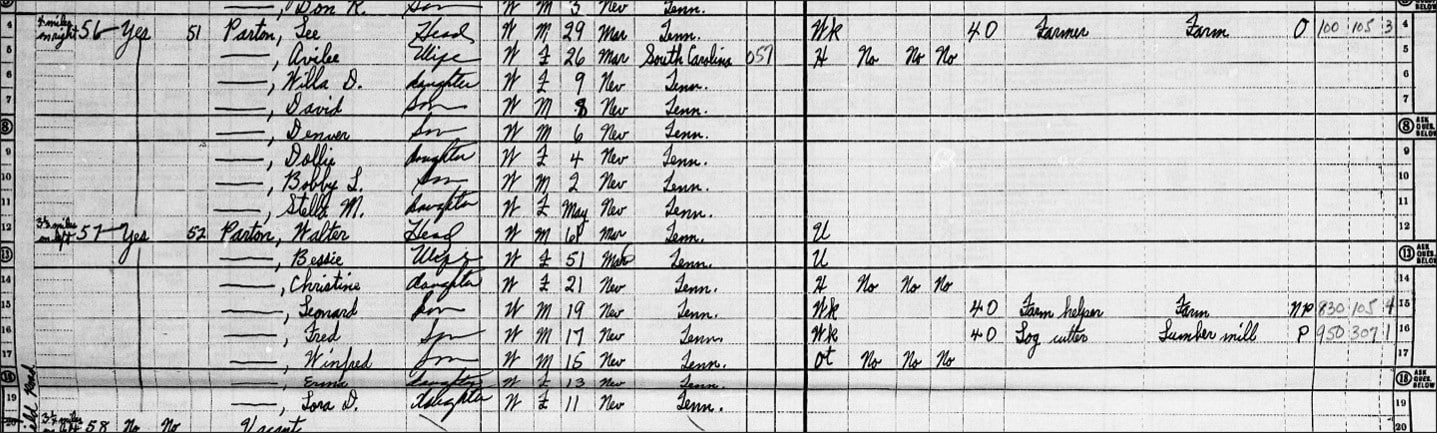
Using the information learned from the 1950 census, the Parton family can be traced back another 10 years to 1940. Census research can be tricky. Sometimes people were missed or recorded with information that you may not expect, making it harder to find them. The person who gave the information to the census taker could be anyone – the person themselves, a household member who might be making guesses, or the next-door neighbor. This may have been the case for Dolly’s father’s entry in the 1940 census, as he was not found. However, Dolly’s mother, Avie Lee, was found. She was enumerated with her parents, Jake and Rena Owens, as well as her siblings Estel, Lester, Dorothy, Henry, Lewis, Billy, and Alden. [2] She was recorded as Avilee Parton, was 16, and was listed as married. She was also listed as born in Tennessee, contrary to the 1950 census, which recorded that she was born in South Carolina. Information in census records sometimes differs for a person from census to census. Comparing several census entries and using other records other than the census can help to resolve conflicting information.
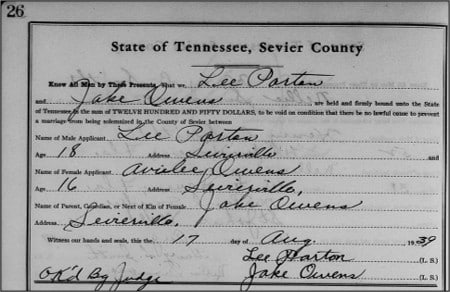
Vital records, when available, are also one of the first records researchers turn to. Dolly’s parents' marriage took place in Sevier County on 17 August 1939. [3] Their marriage record showed that Jake Owens, Avie Lee’s father, married them. Dolly has talked about her preacher grandfather in several interviews.
Following the Parton name backward
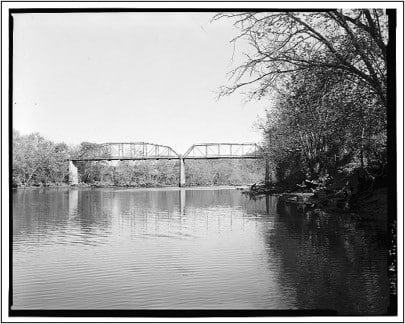
Tracing Dolly’s father back through time in census records showed that he lived in Anderson County, Tennessee, for some time as a child. He and his parents, Walter and Bessie, with his siblings Oscar, Arvil, Earl, Hazel, Rhea, and Christine, were enumerated there in 1930. [4] They lived near the Clinch River. Walter was a farmer, and the census recorded that he was born in Tennessee and that his parents were born in North Carolina.
In 1920, the family was living on Birds Branch in Sevier County, near other members of the Parton family, including Luther, Huston, and James Parton. [5] This time the census reported that both of Walter’s parents were born in Tennessee. This is another example of how information can vary between different records. During this census, Walter worked as a laborer for a logging company.
Working back from census to census and corroborating information with other records such as birth, marriage, and death records, deeds, and newspaper articles traced the Parton family back to Dolly’s great-great-great-grandparents, Benjamin and Hannah Parton. They settled in Sevier County between 1850 and 1853, after having lived in Murray County, Georgia, for some time, and Greene County, Tennessee, before that. This was the first of Dolly’s paternal line to settle in Sevier County. The first of Dolly’s Parton ancestors to settle in Tennessee were John Benjamin Parton and his wife, Irene. They came from Burke County, North Carolina, and settled in Greene County, Tennessee, by 1840.
Don’t stop with the Parton surname
Following the paternal surname is often easier than following maternal lines, but it creates a distorted picture of ancestry if we stop there. Half of Dolly’s ancestry came through her mother, Avie Lee Owens, and every generation backward doubles the number of ancestral lines available for research.
Identifying the maiden name of a woman can be a difficult, but not impossible, task, especially for women in early 19th-century Appalachia. One such example of the extra work it takes to identify a maiden name appeared in the research on Dolly’s maternal great-great-grandmother, Rebecca Dunn Whitted (Rebecca evidently was a family name on Dolly’s maternal great-grandmother’s side). Born on 24 August 1861 in Sevier County, Rebecca married Dolly’s great-great-grandfather, William Jesse Whitted, on 26 December 1877 in Sevier County. [6] Their marriage license recorded Rebecca’s last name as Dunn. Rebecca was enumerated in the 1870 census with Louisa Dunn, who appears to be the mother of Rebecca and the other children in the household, which included David, William, Louisa, Archey, Arthur, and Chelnetty Dunn. [7] No father appears in the household, and Chelnetty was born just two months before the census enumeration.
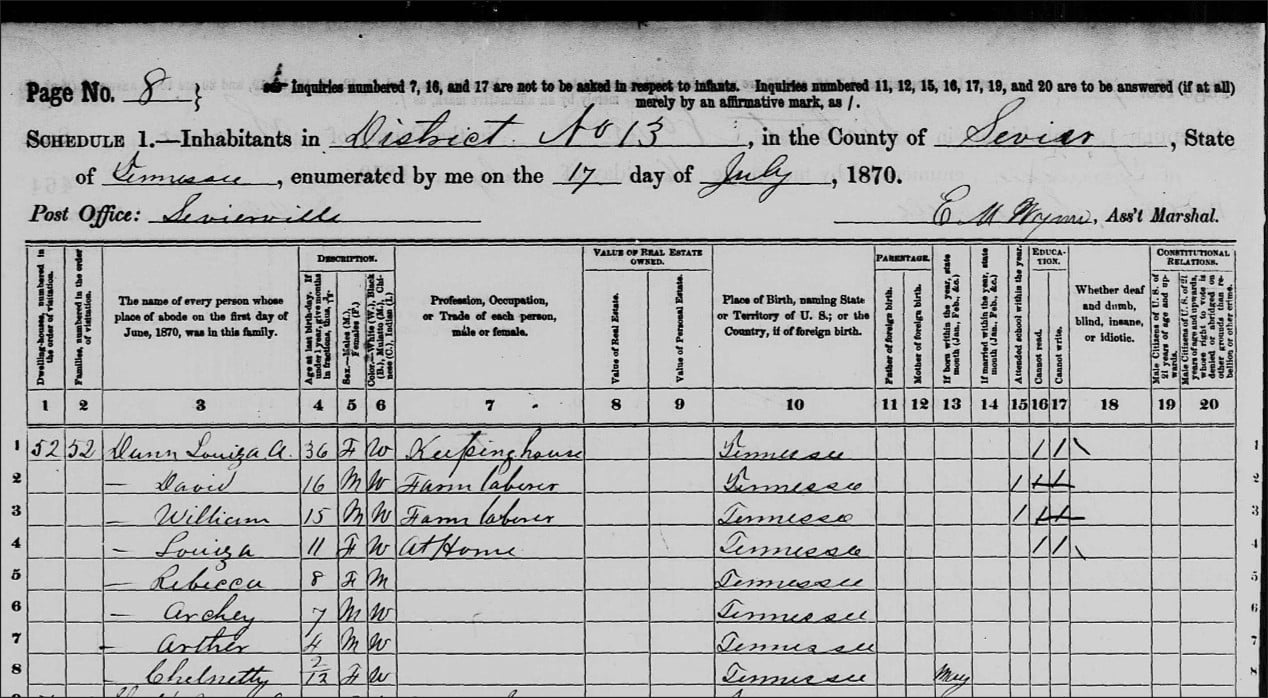
If we go back another 10 years, to the 1860 census, we find the children, David, William, and Louisa Dunn, of the appropriate age, in the household of Louisa Dunn, presumably their mother. It is interesting to learn that Louisa cannot read or write. [8] Again, no adult male is enumerated in the household, and Louisa was 11 months old. Who was the father of Rebecca Dunn? Who was the father of the other Dunn children? Was Dunn Louisa’s maiden name or married name? These are just some of the questions that arise when researching maiden names and identifying fathers.
The answers to these questions are not likely to be found in census records. Other records have to be consulted to build a timeline and profile for Louisa’s household. Online trees list John Stinnett as the father of Louisa’s children, including Rebecca, but no sources confirmed this. [9] Probate documents may identify married daughters or sons-in-law. Deeds can reveal land transfers among relatives, and witnesses, bondsmen, and neighbors may eventually reveal relationships that are not stated explicitly anywhere else.
Dolly’s ancestors did not live in isolation
Though Appalachians in the early 19th century did live sparsely across the region, people rarely lived in near isolation. Families and communities who moved together from North Carolina and Virginia settled in communities together in the new land or joined an already established community. This highlights a great reason to research your ancestor’s community, or what genealogists call FAN Club research.
FAN Club means researching the friends, associates, and neighbors of your ancestors. Doing so often breaks long-standing genealogy brick walls. When researching, keep track of who your ancestors lived by, sold and bought land with, the bondsmen, or people they were a bondsman for, and the people with whom they worshiped. If you’re unsure about where your ancestor migrated from before they settled somewhere, tracing the origins of their FAN club and members of their community often leads to great clues about where to look for your ancestor.
This approach is valuable in Appalachian genealogy research because geographically concentrated communities produce a dense network. The person who lived next door may be a brother-in-law, cousin, widowed parent, married daughter, or former neighbor who migrated with the family from another state.
Geography matters in Appalachian genealogy
Knowing geography works hand-in-hand with researching your Appalachian ancestors. Mountains, valleys, rivers, gaps, roads, and waterways affected where people settled and with whom they interacted. Two families living in different counties might have been only a short distance apart. Conversely, two locations that appear close on a map may have been separated by difficult terrain.
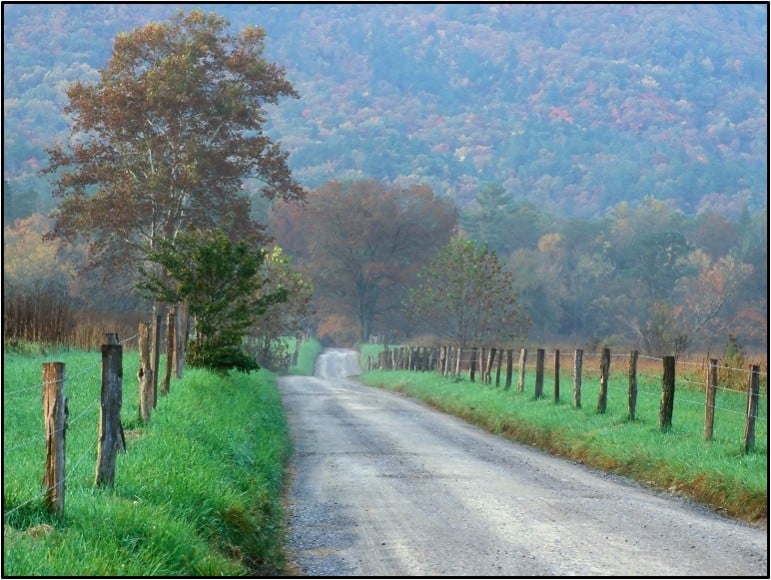
Dolly has deep roots in Sevier County, Tennessee. Knowing the geography and history of the location helps to understand why her ancestors settled there. Sevier County borders the North Carolina counties of Haywood and Swain. Dolly’s Whitehead ancestors were from Haywood County, North Carolina, and settled in Sevier County, Tennessee, but did not have to move very far.
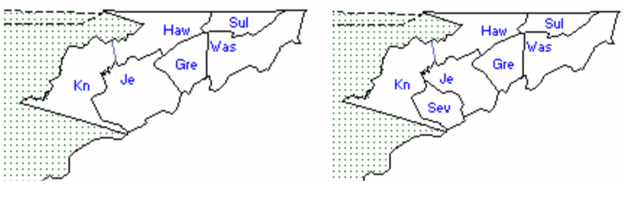
County formation and boundaries are also important to know. A great tool to see the transformation of county borders in the United States is mapofus.org. Using the map, you can see that Sevier County was formed in 1794 from Jefferson County. So, if you have ancestors who appeared in 1793 in Jefferson County and then in Sevier County in 1795, it doesn’t necessarily mean they moved; instead, the borders around them may have changed.
What do online family trees say?
Eventually, nearly every genealogy investigation reaches a point where the internet becomes very confident while the evidence becomes even less so. A relationship added to one public family tree can be easily copied into another, and then that tree can be easily copied. Soon enough, dozens or hundreds of online trees may identify the same parents, but all stem from one tree. That is why it is important to use online trees as hints and not conclusions. Evaluate the documentation, corroborate facts with original records, and work towards following the Genealogical Proof Standard when proving a relationship.
For example, the FamilySearch Family Tree traces the Parton line back into the 1500s in England, and on some of her other lines, back into the early 1400s. But few profiles show actual documentation of a true relationship between each generation.
What Dolly Parton’s family tree can teach us
Dolly’s ancestry is interesting because Dolly Parton’s deep Appalachian roots were a big part of her image and personality. But the research methods used to learn about her family are the same ones that can be used on any family.
Her tree showed the importance of geography, investigating maternal families rather than simply following a surname, and it illustrated why neighbors, witnesses, in-laws, landowners, and other associates can be just as important to your research as your ancestor.
The research problem identified with Dolly’s ancestor Rebecca Dunn is one that many genealogists may be presented with in their own research. Learning to work from the known information into the unknown slows down the process so that you can analyze each piece of information and make note of important details such as members of your ancestor’s FAN club.
Dolly’s legacy and impact on the world will continue to live for generations to come. The imprint that the Appalachians have made on her personality, values, and artistry is a reflection of her family, both now and long ago.
If you’d like to learn more about your Appalachian ancestors, contact our talented researchers at Price Genealogy.
Tyler
Sources
[1] 1950 U.S. census, Sevier County, Tennessee, District 13, enumeration District (ED) 78-28, sheet 8, household 56, line 9, Dollie Parton; imaged, “United States Census, 1950,” FamilySearch (https://www.familysearch.org/ark:/61903/1:1:6FS7-B61B : 14 September 2026).
[2] 1940 U.S. census, Sevier County, Tennessee, 13th District, population schedule, enumeration district (ED) 78-21, sheet 13A, household 191, Avilee Parton; imaged, “United States, Census, 1940,” FamilySearch (https://www.familysearch.org/ark:/61903/1:1:K4Z5-RYZ : accessed 14 September 2026).
[3] Sevier County, Tennessee, Marriages, 26:26, Lee Parton and Avilee Owens, 17 August 1939; “Tennessee, County Marriages, 1790-1959,” database with images, FamilySearch (https://www.familysearch.org/ark:/61903/1:1:QKHQ-BT1K : accessed 14 September 2026); FSL film 5728925, item 2, image 39.
[4] 1930 U.S. census, Anderson County, Tennessee, Civil District 9, page 123 (stamped), enumeration district (ED) 1-12, sheet 2B, dwelling 36, family 36, Lee Parton; imaged, “United States, Census, 1930,” FamilySearch (https://www.familysearch.org/ark:/61903/1:1:SP7B-VJB : accessed 14 September 2026).
[5] 1920 U.S. census, Sevier County, Tennessee, Second Civil District, page 73 (stamped), enumeration district (ED) 138, sheet 14B, dwelling 248, family 251, Walter Parton; imaged, “United States, Census, 1920,” FamilySearch (https://www.familysearch.org/ark:/61903/1:1:MNP1-F4F : accessed 14 September 2026).
[6] Find a Grave, database with images (https://www.findagrave.com/memorial/7502034/rebecca-whitted : accessed 14 September 2026), memorial 7502034, imaged gravestone for “Rebecca Whitted (1861-1930), died 16 January 1930”, photographer Deanna (Mrs. Virgil G) Cooley; citing Shady Grove Cemetery, Richardson Cove, Sevier County, Tennessee.
Sevier County, Tennessee, Marriage Licenses, 2:167, no. 666, William Whithead and Rebecca Dunn, 26 December 1877; “Tennessee, County Marriages, 1790-1959,” database with images, FamilySearch (https://www.familysearch.org/ark:/61903/1:1:QKH3-5PDF : accessed 14 September 2026); FSL film 5728642, image 368.
[7] 1870 U.S. census, Sevier County, Tennessee, population schedule, District 13, page 8, dwelling 52, family 52, Louiza A Dunn; imaged, “United States, Census, 1870,” FamilySearch (https://www.familysearch.org/ark:/61903/1:1:MD8S-NZ8 : accessed 14 September 2026).
[8] 1860 U.S. census, Sevier County, Tennessee, population schedule, District 2, page 29, dwelling 186, family 186, Louisa Dunn; imaged, “United States, Census, 1860,” FamilySearch (https://www.familysearch.org/ark:/61903/1:1:M8TV-QNC : accessed 14 September 2026).
[9] “Family Tree,” database, profile for John Stinnett (1835-1910), PID (KGCV-DPF); FamilySearch (https://www.familysearch.org/en/tree/person/details/KGCV-DPF : accessed 14 September 2026).
Images
- Dolly Parton at the Grand Ole Opry, 2005. Photo by Tech. Sgt. Cherie A. Thurlby, U.S. Air Force, 25 April 2005. Public domain, U.S. Government work. Courtesy of Wikimedia Commons.
- Historic American Engineering Record, Creator, and Virginia Bridge & Iron Company. Massengill Bridge, Coal Creek Road, spanning Clinch River, Norris, Anderson County, TN. Documentation Compiled After. Photograph. Retrieved from the Library of Congress, <www.loc.gov/item/tn0175/>.
- Morning in Cades Cove, Great Smoky Mountains National Park. National Park Service photograph. Public domain.
- Publicity shot of American singer Dolly Parton, 1977, 22 Mar 1977, Public domain. Courtesy of Wikimedia Commons.